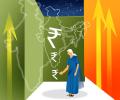
The International Monetary Fund (IMF) has increased India's growth forecast to 7 per cent for 2026-27, up from 6.4 per cent, attributing this robust outlook to resilient domestic demand and strong services activity, positioning India as one of the fastest-growing major economies.

Indian government bond yields have recorded their worst losing streak in three decades, rising for the tenth consecutive week, driven by elevated crude oil prices and increasing global yields. The rupee also weakened, and India's foreign exchange reserves saw a significant decline.

Former Chief Economic Adviser Krishnamurthy V Subramanian outlines India's strategy to become a USD 55 trillion economy by 2047. The plan hinges on leveraging its young demographic in AI, dominating sunrise sectors like space and defence tech, attracting FDI, and achieving sustained 8% GDP growth.

The Unified Payments Interface (UPI) has completed a decade since its launch, becoming the backbone of India's digital payments ecosystem. It has seen exponential growth in transaction volume and value, expanding financial inclusion and setting a global benchmark for real-time payments.

BRICS members have expressed 'serious concerns' over the unilateral imposition of trade and finance-related measures, including higher tariffs and non-tariff barriers, stating these actions distort trade and are inconsistent with WTO rules. The grouping also highlighted elevated risks to the global economic outlook due to geopolitical tensions, trade fragmentation, and protectionism.

As the world's most populous country, India's economy looks large in the aggregate even as its average incomes stay modest.

'This rise in foreign exchange reserves was expected given the amount of FCNR(B) flow.'

The International Monetary Fund (IMF) has reduced India's growth forecast for FY27 to 6.4 per cent, citing the potential impact of higher energy prices offsetting the country's economic resilience. Despite this, India remains among the fastest-growing major economies.

For India, the goal is not simply to host another grand diplomatic gathering. It is to prove that a diverse coalition of emerging powers can still deliver.

India and China are in what experts call 'a cooperation-versus-competition situation'.

The University of Chicago has conferred its Alumni Award for Professional Achievement to India's former chief economic adviser Krishnamurthy V Subramanian, the first Indian economist to receive the honour since 1941.

'The prohibition regime has been accompanied by concerns regarding the expansion of the illicit liquor trade, increased enforcement challenges and corruption, and the growing use of alternative intoxicants, including illicit drugs.'

Institutional portion subscribed 12.68 times; retail crosses quota.

The Asian Development Bank (ADB) has revised down India's GDP growth forecast for fiscal year 2026-27 (FY27) to 6.6 per cent from an earlier 6.9 per cent, primarily attributing the change to elevated energy prices stemming from the Middle East conflict. Despite this moderation, India is still expected to remain the world's fastest-growing major economy.

NPCI International Payments Ltd (NIPL) and Maldives Monetary Authority (MMA) have successfully integrated the Maldives' instant payment system 'Favara' with India's Unified Payments Interface (UPI). This enables real-time fund transfers from Maldives to UPI-enabled Indian bank accounts, marking a significant step in cross-border digital financial connectivity and bilateral economic cooperation.

'I don't think the government will sacrifice such a fine institution for monetary gains.'

RBI Governor Sanjay Malhotra stated that the central bank is closely monitoring whether the supply shock from the West Asia conflict will lead to a generalised price rise, potentially necessitating monetary policy action.

Investors opening new brokerage accounts must choose a broker suited to their style.

In a world fractured by uncertainty, India stands out for its policy consistency, paired with sustained ambition, points out Pritam Banerjee.

India emerged reasonably well from 2025. But now, the oil shock and war-related supply disruptions have again driven funds out of India and significantly weakened the rupee, points out Ajay Chhibber.

'It is not because of the war in West Asia, which began on February 28.' 'Petroleum product prices are already going through the roof. They are bound to have a serious inflationary impact.' 'A country's leadership is tested in trying times. It is here that the current leadership is failing.'
Unified Payments Interface (UPI) has reached a record Rs 314 lakh crore in transaction value in FY26, representing more than a 4,000-fold increase since inception.
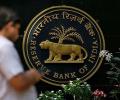
The Reserve Bank of India (RBI) has introduced a new framework allowing banks to offer differential interest rates on bulk deposits based on their liquidity characteristics under the Liquidity Coverage Ratio (LCR) framework, while maintaining the principle of uniform pricing across similar deposits.

'If the war continue for a longer period of time, it is just a matter of time before the government will pass on some of the price increases.'

rediffGURU Vipul Bhavsar answers readers' personal income tax queries

The Reserve Bank of India's proposal to allow non-banking financial companies (NBFCs) access to the term money market is projected to significantly increase market volumes by 40-60 per cent in the first year, potentially doubling turnover within two to three years, according to treasury executives.

The IMF on Monday raised India's growth projection to 7.3 per cent for fiscal 2025-26, up 0.7 percentage point from its October forecast, on the back of better-than-expected performance of the economy. The Washington-headquartered multilateral lending agency has also revised India's Gross Domestic Product (GDP) growth forecast to 6.4 per cent for fiscal year 2026-27 beginning April 1, 2026, from its earlier estimate of 6.2 per cent.

In its June 2025 review, the International Monetary Fund spotlighted India's Unified Payments Interface as the world's most dominant retail instant-payment network, moving more transactions than any other system on the globe.

For India, much is at stake: Crucial energy supplies traversing the Strait of Hormuz, the fate of its 10 million citizens living and working in West Asia -- who send generous remittances home -- and its major trade links with the region.

India has opposed the International Monetary Fund's (IMF) proposal to extend fresh loans of USD 2.3 billion to Pakistan, citing concerns that the funds could be misused for financing state-sponsored cross-border terrorism. India abstained from voting at the IMF meeting, expressing concerns about Pakistan's track record and the possibility of debt financing being misused for terrorism. The IMF took note of India's statements and its abstention from the vote. India's opposition comes at a time when military conflict between India and Pakistan has intensified following a terrorist attack in Kashmir.

Ashok Lahiri, a distinguished economist with experience in government, the private sector, and electoral politics, has been appointed as the new Vice-Chairman of NITI Aayog, tasked with strengthening India's reform trajectory and policy-making.

India's Code on Wages mandates strict payout deadlines, two-day full and final settlements, universal wage coverage and capped deductions to safeguard employees and enhance payroll transparency nationwide.

India should refrain from playing cricket with Pakistan in view of the ongoing tension with the neighbouring country, Arvind Sawant (SS-UBT) said on Monday in the Lok Sabha.

The contraction in total reserves was driven by a fall in gold reserves, which dropped $13.49 billion to $117.19 billion during the reported week.
About 85 per cent of the digital payment transactions take place through UPI in India, and the country can be a case study in inclusive, secure, and scalable Digital Public Platforms (DPPs), Reserve Bank Governor Sanjay Malhotra has said. He was speaking at a "High-Level Dialogue on Forging Economic Resilience through Digital Public Platforms" organised by RBI on the sidelines of the Annual Meetings of the World Bank and International Monetary Fund in Washington, DC on Tuesday.

The International Monetary Fund, in its report on the Indian economy, said the Insolvency and Bankruptcy Code (IBC) Amendment Bill addresses many deficiencies but it has not provided for the participation of operational creditors or rules for executory contracts. The IMF staff report said that the business dynamism in India remains relatively low, marked by low rates of entry and exit, and a high share of inactive or inefficient firms reflecting structural rigidities and high compliance levels.

The International Monetary Fund (IMF) has said the tightening of monetary policy by India is an 'appropriate' step, as the country is faced with high inflation and needs to consolidate the fiscal measures initiated during the slowdown.

The Indian government has expressed its disagreement with the IMF staff's 'baseline' assumption that the 50 per cent US tariffs on its goods exports 'would remain in place indefinitely', based on which the staff pegged the country's GDP growth at 6.6 per cent this year, and pared its 2026-27 projection by 20 basis points to 6.2 per cent.
The Indian economy is likely to grow at 7.4 per cent in 2025-26, up from 6.5 per cent in the previous fiscal, mainly on account of better performance of manufacturing and services sectors, as per the government data released on Wednesday.

India has managed high government debt-to-GDP, a slowing domestic revenue engine, lower household savings and a more hostile geopolitical environment separately in the past. But together, they threaten to undo the growth narrative on which today's optimism rests, warns Debashis Basu.
